
More Than Retail: Goodwill Industries of Middle Tennessee
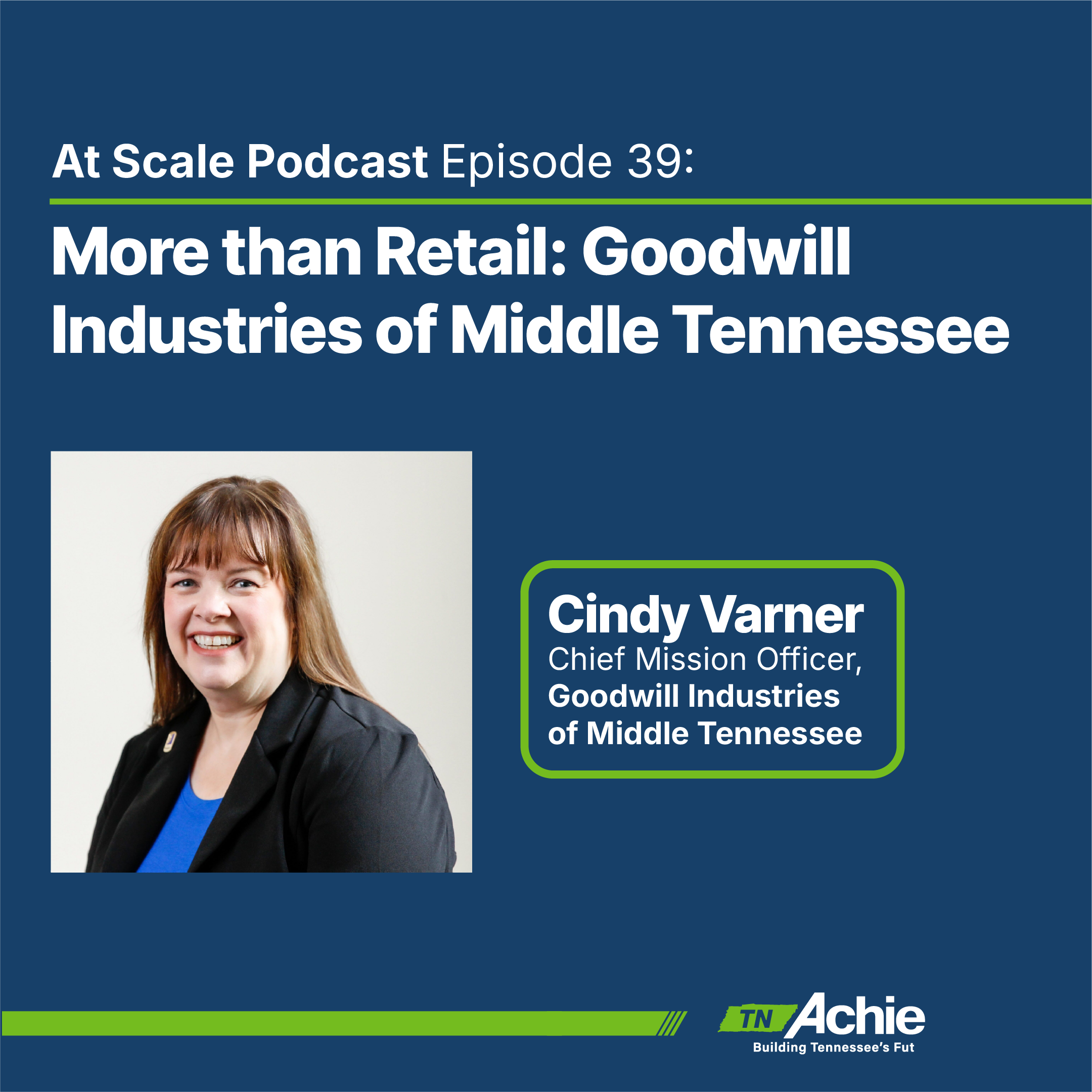
Cindy Varner on short-term training, adult education and helping every Tennessean see the path ahead
Goodwill is one of the most recognized names in the country, and most people connect it with its stores. Cindy Varner, Chief Mission Officer at Goodwill Industries of Middle Tennessee, wants people to know what those stores make possible. “Retail is what fuels our mission,” she told hosts Ben Sterling and Graham Thomas on the newest episode of At Scale.
Goodwill Industries of Middle Tennessee is the largest of five Goodwills in the state and serves 48 counties, from Lauderdale County in the west to Cumberland County in the east. Store revenue supports a mission of changing lives through education, training and employment, for its 1,900 employees and for the broader community. A mission impact plan guides that work with three pillars: expanding access, advancing economic mobility and building sustainable impact.
Cindy spent the first 20 years of her career in Arkansas state government, working on workforce development policy and serving as staff director for the state workforce board. Over time, she said, she felt disconnected from the people that work was meant to serve. In 2017 she joined Goodwill Arkansas to open the state’s first adult high school, a move that felt risky at the time and that she now calls the biggest blessing of her career. After three years with Goodwill in Dallas, she came to Middle Tennessee in 2023.
The newest piece of that work is an Opportunity Center in Nashville’s MetroCenter, which Goodwill moved into in September. The campus brings programs that were once spread across the city under one roof and on a public transportation line. It houses Goodwill’s career and technical academy training programs, an on-site career center and community meeting space that partners can use. A child care center is planned for spring 2027, and Goodwill hopes to open an adult high school on the campus around 2029.
Reaching 48 counties takes more than one building. Goodwill runs a mobile career center equipped with computers and has partnered with Second Harvest to bring it to food distribution sites. A new virtual career navigator serves people anywhere in Goodwill’s territory, and two distance learning classrooms let students in rural communities join training programs and interact with their instructors and classmates in real time.
Training currently covers construction, welding and IT, from digital literacy to advanced certifications. Healthcare launches this fall with patient care technician training in partnership with Nashville State Community College, followed by a certified medical assistant program in the spring. Every program starts with employer demand. “We never want to train people for jobs that do not exist,” Cindy said.
Each industry has a business advisory council that shapes curriculum, evaluates programs and spends time with students, sometimes over lunch and sometimes with job-site simulators. The message from employers is consistent. One told Goodwill, “I need you to not only teach them how to swing a hammer, but how to stay on the job site.” Showing up on time, communicating with supervisors, accepting feedback and solving problems matter in every role.
Every person who comes through a Goodwill center receives an individual career and financial plan that maps the next 90 days, the longer career path and the barriers to address along the way, from housing and transportation to child care. Students in training programs receive a stipend of at least $150 a week. For many participants, Cindy said, a short-term program is the first step. They see what they can do and then pursue a credential at a TCAT or community college.
The Excel Center model, developed by Goodwill in Indianapolis in 2010, is designed for adults: year-round eight-week terms, a life coach for every student, free on-site child care and licensed teachers in small classes. Cindy said there are now 42 Excel Centers in 11 states, and the model has been studied for a decade by the Wilson Sheehan Lab for Economic Opportunities at the University of Notre Dame. Beyond Nashville, Goodwill has identified six more counties with high concentrations of adults without a high school diploma. Assessments help students rebuild skills before they move forward. “Algebra was hard at 16,” she said. “It is really hard at 36.”
The conversation kept returning to shared work. Goodwill’s three pillars line up closely with the work of tnAchieves, and Tennessee’s Drive to 55 made clear years ago that the state could not reach its goals through high school graduates alone. Many tnAchieves students already complete community service at Goodwill stores. Cindy sees room for more: referrals in both directions, resume and interview support and digital skills that help students start college prepared. As a first-generation college graduate who worked her way through school, she knows what that support can mean.
Asked what Tennessee does well, Cindy pointed to how closely state government, nonprofits and education work together, along with the affordability Tennessee Promise provides. Her wish list for the state comes down to one item: that every Tennessean could see their pathway and know how to access the resources to get there.
Listen to the full conversation at tnachieves.org/news/goodwill, or find At Scale on Spotify, Apple Podcasts and YouTube.